Blog

Potty Training

Pandemic Potty Training

It has been too long since you’ve heard from me. Sorry! As I’m sure every one of you knows, this year has been strange. Things have been different. Things will never be the same.

Apart from the obvious pandemic, our family welcomed a new baby into our family, so we are starting a new journey to toilet independence all over again. Our Little Dude had his first EC catch when he was 2 days old, and has been on the potty every day since. I have no idea when he will finish – every child has their own unique journey – but I am confident that his experience with EC will serve him well when it’s time to potty train, just as it did for his brothers.

While the pandemic has been so hard in so many ways (our baby is still waiting to meet his grandparents 😦 ), it has also presented some unique opportunities to some families. I have had many clients who have decided to take on potty training because they are home with their children, when they may have delayed jumping in, either because they just didn’t have enough time with their kids, or in the vague hope that daycare would spearhead it for them. I have seen parents newly able to tune into their children’s signals, improve their communication and reduce their power struggles. While their have certainly been many challenges (like juggling full-time work from home while entertaining and homeschooling stir-crazy little ones during all the shut-downs), some parents have managed to embrace the rare opportunity this time has given them to connect in new ways to their children and come up with creative approaches to make sure everything (or almost everything) still gets done.

July is often a month of panic for some families with potty training on their minds. Often, parents are concerned that their children, entering Kindergarten or a new preschool with potty training requirements just won’t be ready in time. This year, with so much uncertainty about how the new school year will unfold, these feelings may be even more complicated or more intense.

Breathe.

We have come so far. As a family. As a community. As a country. We will get through this together. We’ve got each other’s backs.

Take this time – this strange, scary, confusing, but also unique time – to notice and get to know your children in a new way. Be creative. Be compassionate. This time is just as overwhelming and confusing for them. Work together as a family and be there for one another.

If your child has yet to begin their journey to toilet independence, this might be a great time to start. Whether you have a child closing in on Kindergarten who needs to potty train quickly, a toddler who you’d like to see take charge of their own hygiene needs, or a baby who you’d like to help keep attuned to their body through Elimination Communication, having a little extra time together might give you a rare opportunity to help them along their journey with deepened communication and understanding – something that will only help to bring you both success and a shared feeling of pride in your achievements.

Be well. You’ve got this.

silhouette-of-man-touching-woman-against-sunset-sky-256807


Potty Independence, Potty Training

Summer is Here – Time to Play, Party, Picnic, and… Potty Train!

The first day of summer and longest day of the year is now past. It really crept up on me this time, partly because I’m running after two very active little boys and can barely keep track of the days of the week, and partly because it never felt like we had a spring. In Toronto, we have had a cold, wet and dreary season full of chilly rain, mud and very few flowers, but suddenly we’re seeing some sunny warm (even hot!) days, accompanied by bursts of colour that beckon us outside.

For many, summer is the time to take a vacation, to have street parties, to get off work early and relax. Many kids are home, at camp, or enjoying fun activities as they recharge from their school year. The long, lazy days of summer are two months of the year where it’s okay to be out of our normal routines.

For some parents and kids, however, this summer is not quite like others. This summer is the summer before the start of Junior Kindergarten – a major transition for many 3 and 4 year old children and their families, including my own. The start of Kindergarten brings with it a plethora of emotions for children and parents alike – from excitement and anticipation to trepidation and anxiety. A journey into unknown territory of new people, new environments and new routines.

Parents want the best for their children, and so many of us put a lot of effort into preparing our children for Kindergarten. From reading stories about the first day of school in an effort to ease anxieties, to trips taken to the school playground to familiarize our children with their future daytime environment, to special back-to-school outfits, lunchboxes or backpacks that mark this special rite of passage, a lot of thought goes into making our children’s transitions to school as pleasant as possible.

Some parents and children, however, face added stress and anxieties about starting school because of potty training. With the age of potty training completion rising year after year, a culture that expects children to tick off a “readiness” checklist before starting to train, and the expectation that children will self-initiate the process, many 3 and 4 year old children have either not finished or not yet begun their potty training process. This isn’t the fault of the parents or the children. It is the inevitable result of the current prevailing potty training culture in North America. This culture has parents scared to attempt potty training their children, for fear of damaging them psychologically or even physically, which are understandably outcomes no parent can bear to think they might inflict.

For families like these, where potty training is not yet complete (or not yet begun), and the child will be entering Kindergarten in the Fall, a LOT of stress and pressure can be put on the need to finish the process in the next couple of months. Unfortunately, stress and pressure are the fastest ways to derail the potty training process. Every year, I hear more and more stories of parents who spend an entire summer focused on the need for their child to be potty trained, and who try method after method with varying degrees of success, week after week, as the pressure mounts. I hear of children who are put through intensive training on the labour day weekend in a desperate final attempt to prepare them for school. I see families who have missed out on their opportunity to enjoy a very special summer focusing on the exciting aspects of this transition.

If this is you – if your child is not yet trained and will be entering Kindergarten in September, my advice to you is to begin now. While it is absolutely possible to potty train many children at a quick pace over 3-10 days, do not wait until August. Why? First, because there is a difference between being potty trained, and being toilet independent, and sometimes tying up those loose ends to help your child reach toilet independence takes a little bit of time. Second, because every day that passes increases the need, and therefore the stress and pressure, for your child to be potty trained. And as I’ve already mentioned, there is no faster way to derail the potty training process than injecting it with stress and pressure. Starting now will give you the time you need to train your child calmly and respectfully, while allowing your own stresses a little room to breathe.

If your child still has a year or more before Kindergarten, my advice to you is… to start now! If you have been following me, know my website or know me and my philosophies, you’ll know that I believe children of ALL ages and abilities can start their journey to toilet independence at any time. With babies 0-18mth, this can be done through Elimination Communication, and children 18mth+ through Non-Coercive Potty Training. No “Readiness” checklists need to be met, no developmental milestones crossed, no level of self-initiation or interest declared. Through a confident, parent-led approach, your child can be potty trained without coercion, and without causing psychological or physical damage. What determines when a child can begin their journey to toilet independence is whether or not the parent is ready, not the child. So take the lead, declare your readiness and march boldly ahead! When the summer before Kindergarten comes, you won’t regret you did.

Potty Independence, Potty Training

The Dreaded Potty Regression!

Today, I want to talk a little about regressions. If you’ve read some of my other posts, you know that we potty trained our youngest at 18mths, and it went really well. At 20mth, he was basically 100% reliable, even at daycare, save for the very occasional times of extreme excitement where he just couldn’t be aware enough of his body. But 1 accident in a 2 week period at 20 months was pretty good – we certainly weren’t complaining!

Then, all of the sudden, at close to 22mth, he started having a lot more accidents. They weren’t when he was running frantically with his brother, but just any time, as though he couldn’t be bothered anymore. Instead of running up to us saying “pee poop!” when he had to go, he would walk over and state “pee… wet.” and he’d be soaked.

As parents, when things are going well, we can start to take them for granted. We expected him not to have any issues because he hadn’t been having any issues… but that’s not a realistic expectation in the toilet learning process. While it’s absolutely natural to feel frustrated or annoyed that your [previously accident-free] toddler or preschooler is now standing in the middle of the floor and peeing without even moving towards a potty, this is one of those times in parenting when you need to gather yourself, take a deep breath, and remind yourself of all the amazing developments these little people are going through. They truly have a LOT on their plates, and sometimes, some processes will take a step back to give others space to flourish. But don’t worry – your child will get back to consistent potty habits soon – once a little equilibrium is reached.

So, what can cause a regression in the toilet learning process? In truth, almost anything.

  • Any change in environment – a move; a new daycare, preschool or school; a new caregiver at home; a parent going back to work or changing jobs; a pregnant parent; a new sibling; a vacation away from home; etc. – can cause a regression.
  • Any change in emotional environment – parental discord, stress, or anxiety; divorce; parent-child discord, receiving less attention or feeling less attachment, feeling parental pressure; tension with a sibling; poor relationship with a caregiver or teacher in the home or at a daycare, preschool or school; etc. – can cause a regression.
  • Physical changes – growth spurts; teething; sleep regressions; illnesses; etc. – can cause a regression.
  • Developmental changes – mental leaps and new understandings of the world; learning to talk; learning a new base skill; etc. – can cause a regression, too.

If you look at this list, how many toddlers and preschoolers do you know who live in a perfect balanced stasis where nothing is changing in their environment, their bodies or their minds? None. Even in a household of perfect calm (which I am going to guess is pretty rare), a child of this age isn’t healthy unless they are growing and learning all the time. Sometimes, all of that growing, processing, learning and understanding takes precedence over your child’s ability to tune into their body and keep their toileting on track. And that’s okay. In fact, it’s normal, healthy, expected, and a sign that your toddler or preschooler is doing everything they’re supposed to be.

For us? Well, our little guy is just at the beginning of a language explosion, all 4 of his canines are swollen and expected to cut soon, and he has a really bad cold. The culprit? Who knows! Any of those could cause a regression on their own, let alone in combination! But it doesn’t really matter. A regression is not a sign of anything going wrong, but rather that your child is totally on target!

Regressions are not forever. Yes, they can be frustrating, annoying, infuriating, or evoke any number of complex emotions from parents, but they will pass fairly quickly. Soon, they will become a tiny blip in your child’s toilet learning journey that you probably won’t even remember in a year or two, when you’re recounting potty training stories to friends.

To survive a regression, just stay consistent, kind and compassionate. Gently but firmly remind your child that pee goes in the potty/toilet, not in pants or on the floor. If you, like me, had moved into a place of taking your child’s toileting practices for granted, take a step back and re-attune to their signals so you can help them be successful. Do everything you can to avoid getting angry with your child, or shaming them for an accident. This is not their fault. They want to succeed at this, and they want to please you. They didn’t do it on purpose and they don’t want to be wet. Calmly provide them with the extra support they need during this overwhelming time, and they will find their way back to where they were – usually in 2 short (or maybe long…) weeks or less.

So… take a deep breath, take care of yourself (and do what you need to re-centre), and then take a moment to celebrate this time of immense fluctuation in your child’s life. Because a toileting regression doesn’t mean potty training has derailed. Rather, it means that you and your child are right on track!

Elimination Communication, Potty Independence, Potty Training

Spring Has Sprung!

It’s finally here! I hope, wherever you are, you have had a lovely winter. In Toronto, it has been long, cold, and full of inhospitable weather! I love a nice snowfall, winter play, and being outdoors, but this year’s extreme cold, preponderance of freezing rain/ice pellets/rains followed by flash freezing/ etc. have made enjoying the winter with my two kids under 4 a challenge. However, with the arrival of the first day of spring we have finally seen some temperatures above zero and the melting of the massive amount of ice that had accumulated under the snow this season. Spring has arrived – I’m sure we’ll be seeing those first blossoms soon!

Not that we didn’t get some benefits out of winter… Since my youngest started his potty training in November, he has made his journey to potty training completion through the cold wintry days. We have thus mastered things like stand-up pees in snowsuits, and giving enough warning of an impending pee to get somewhere appropriate earlier than we did with his older brother. Winter was a time of transformation, and I am glad we had it, but I am certainly ready to move on!

While I wouldn’t normally advise a family contemplating potty training to wait until spring, I am also mindful of how intimidating the extra complications of snowsuits and multiple layers can bring. I recently wrote about simplifying how we dress our little ones to set them up for success, and winter doesn’t simplify anything! I have observed that most people tend to begin their family’s potty training journey in the spring or summer, when clothes are simple and some people have the opportunity to spend much more time outside. If you’ve been waiting, now’s your chance!

Especially if you have a child who will be starting at a new school in September, and you’re hoping they’ll be out of diapers by then, I would strongly encourage you not to wait until summer. Why? Because this will add pressure to you, the parent (as you sense a looming “deadline” for completion), and you will not be able to feel that kind of pressure and stress without it transferring to your child. If there’s one thing kids are really, really good at, it is sensing and mirroring emotions and stress in us. And if there’s one thing that is sure to derail your potty training process, it’s stress and pressure.

If you’re familiar with my posts or my practice, you’ll know that I believe the potty learning journey can begin at any age in a healthy and supportive way, through either Elimination Communication (for 0-18mth) or Non-Coercive Potty Training (18mth+). Kids are ready to learn at any age, so when potty training happens (for children 18mth+) actually depends on when parents are ready to start.

Why not start now?!

Elimination Communication, Potty Independence, Potty Training, Products

Navigating Gear, Part 2 – Toilet Seat Adaptors/Reducers

In Navigating Gear Part 1, I discussed the different types of potties that are out there, and some of their various advantages and disadvantages. But let’s face it, your child will likely not always be able to use a potty. While I do know some people who travel with a potty almost everywhere they go (and depending on the case, I sometimes recommend this), most children will fairly early on need to get used to toileting on… well, a toilet!

The biggest problem with this, is that toilets are NOT made for little bums, and many kids feel insecure or even scared sitting on a grownup toilet seat. Finding the right toilet seat adaptor/reducer for your child can be a lifesaver out and about, can ease discomfort at daycare/preschool, and can help kids to feel like they’re really starting to grow up when they pee or poop on the grownup toilet!

Like with potties, do you NEED a toilet seat adaptor/reducer? No. But, like potties, I do usually recommend them, because they allow your child the flexibility of toileting anywhere, but with the comfort of something familiar and secure.

Also like potties, toilet seat adaptors come in many shapes and sizes, with many different features. We will look at some of these differences today, so help you make an educated decision about whether an adaptor/reducer would be right for your family, and which style might work for you. We’ll look at soft-form, rigid-form, built-in, travel-style and hybrid adaptors/reducers.


Soft-Form


These basic adaptors/reducers are made of a semi-soft coated foam material. Generally, they come equipped with little suction cups that stick onto the existing toilet seat, which keep the adaptor from moving during use (which is very important to a child’s feeling of security). They tend to have deeper depressions, so your child feels like they fit securely in the seat, and this can be a great feature for ECers, young potty trainers, or children with little bottoms, who feel fully supported this way.

One advantage to these is that they are fairly universal, in that no part of them requires fitting into the toilet or toilet seat. Instead, they suction to the top of it, and are thus more flexible in terms of fit to different toilet seat sizes and shapes (including the tiny toilets at daycares/preschools!)

Disadvantages are that they tend to be a bit bulky, and thus are difficult to travel with. The foam material is also less durable, and cracks/tears and other wear will occur much faster, especially if the toilets they are being used on are less supportive to their inherent shape.


Rigid-Form


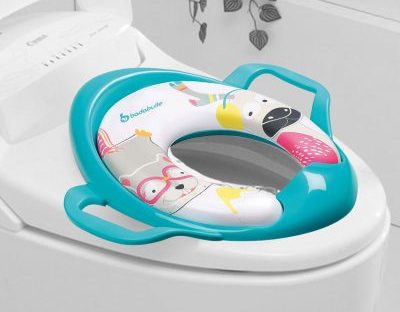
These adaptors are made mostly of hard plastics, although some have a padded seat. Many (although not all) will include handles, which can be an important feature to some children who like to feel control of how they are supported. If you are looking to purchase a rigid-form adaptor/reducer, please take the time to read descriptions and reviews to ensure the one you choose is compatible with (and secure on) your particular toilet seat. Some are definitely designed for standard or elongated toilet seats only, while others do a better job of moving between both styles.

Advantage to rigid-form seats is that they tend to be durable and last a long time, and the structure of them generally helps children to feel secure.

Disadvantages are that they still tend to be bulky and difficult to travel with, they are often particular to sizes and styles of toilet seat, and if the fit isn’t right they can shift around and make a child anxious or fearful.


Built-in


Built-in toilet seat reducers are an extra flap of your toilet seat that tucks away inside the lid but can be easily lowered to make a smaller hole. These are sleek and convenient, but not without their issues. Because they don’t have a lot of form and don’t offer any handles, children can still feel pretty insecure on them, and sometimes the hole they reduce to still isn’t small enough for little-bumed children.

Advantages are that they are always there and kids can lower them easily on their own. Because they’re built-in, they are perfectly suited to your toilet seat and will never shift around.

Disadvantages are that they tend to offer little added security to children who prefer feeling hugged by their adaptor, or who prefer to control their own security with handles.


Travel-style


These adaptors/reducers offer a huge convenience because of their immense portability (they fold up and can generally be easily stored in a standard diaper bag). However, their compact design makes them much less substantial, and they tend to rely on foam pads without much structure to keep they from moving around on the seat. The result is that they may shift during use, which can disturb some children, and while they are usually rated up to 50lbs, they feel flimsier and some children feel like they could break underneath them.

The advantages are that they easily go anywhere, so your child never has to face a gross and unfamiliar public toilet without their adaptor.

Disadvantages are that they tend to feel much less secure, and some children feel just as nervous using them as not.


Hybrid Travel Potties/Adaptors


While not perfect, these can be amazingly useful! These little potties can be setup in potty configuration and used with disposable liners you can throw away, can be used with no liner at all over grass outside, and in the case of the Potette Plus, can be used with a reusable liner as a small but effective regular potty. In toilet seat adaptor/reducer configuration, they span any toilet I have come across and act as a familiar adpator. While not as compact as a travel adaptor, they tend to be smaller than carrying a typical adaptor/reducer, and can go into most larger diaper bags. Their added uses make them extremely flexible, and they are a perect solution for short vacations, road trips, or just to have on hand when out and about.

Advantages are that they can be used in multiple ways for flexibility and conveneince, and that they are fairly compact while still feeling pretty secure.

Disadvantage are that they are a little bulky for everyday out and about, and that they tend to fit smaller bums more easily than larger ones. They can also shift a little on certain toilets, although less so than with typical travel adaptors.


While I won’t get into them here, there are also adaptors that have built-in steps/ladders up to the toilet. While I don’t have personal experience with these, the reviews tend towards them feeling a little wobbly. Personally, I think a good adaptor/reducer paired with a suitable step stool offers your child toilet independence while also having less of a permanent impact on the setup of your bathroom. As an added bonus, any stool they use to reach the toilet can double up as a stool to reach the sink for hand washing!

As always, I hope your family is able to find just the right tools so suit your unique needs! If you want to take a look at some adaptors that we have seen working for people, please visit our resources page, and as always, contact us if you have any questions!