In Navigating Gear Part 1, I discussed the different types of potties that are out there, and some of their various advantages and disadvantages. But let’s face it, your child will likely not always be able to use a potty. While I do know some people who travel with a potty almost everywhere they go (and depending on the case, I sometimes recommend this), most children will fairly early on need to get used to toileting on… well, a toilet!
The biggest problem with this, is that toilets are NOT made for little bums, and many kids feel insecure or even scared sitting on a grownup toilet seat. Finding the right toilet seat adaptor/reducer for your child can be a lifesaver out and about, can ease discomfort at daycare/preschool, and can help kids to feel like they’re really starting to grow up when they pee or poop on the grownup toilet!
Like with potties, do you NEED a toilet seat adaptor/reducer? No. But, like potties, I do usually recommend them, because they allow your child the flexibility of toileting anywhere, but with the comfort of something familiar and secure.
Also like potties, toilet seat adaptors come in many shapes and sizes, with many different features. We will look at some of these differences today, so help you make an educated decision about whether an adaptor/reducer would be right for your family, and which style might work for you. We’ll look at soft-form, rigid-form, built-in, travel-style and hybrid adaptors/reducers.
Soft-Form
These basic adaptors/reducers are made of a semi-soft coated foam material. Generally, they come equipped with little suction cups that stick onto the existing toilet seat, which keep the adaptor from moving during use (which is very important to a child’s feeling of security). They tend to have deeper depressions, so your child feels like they fit securely in the seat, and this can be a great feature for ECers, young potty trainers, or children with little bottoms, who feel fully supported this way.
One advantage to these is that they are fairly universal, in that no part of them requires fitting into the toilet or toilet seat. Instead, they suction to the top of it, and are thus more flexible in terms of fit to different toilet seat sizes and shapes (including the tiny toilets at daycares/preschools!)
Disadvantages are that they tend to be a bit bulky, and thus are difficult to travel with. The foam material is also less durable, and cracks/tears and other wear will occur much faster, especially if the toilets they are being used on are less supportive to their inherent shape.
Rigid-Form
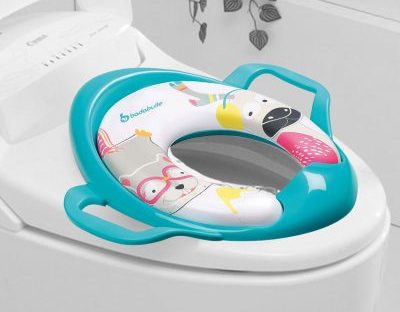
These adaptors are made mostly of hard plastics, although some have a padded seat. Many (although not all) will include handles, which can be an important feature to some children who like to feel control of how they are supported. If you are looking to purchase a rigid-form adaptor/reducer, please take the time to read descriptions and reviews to ensure the one you choose is compatible with (and secure on) your particular toilet seat. Some are definitely designed for standard or elongated toilet seats only, while others do a better job of moving between both styles.
Advantage to rigid-form seats is that they tend to be durable and last a long time, and the structure of them generally helps children to feel secure.
Disadvantages are that they still tend to be bulky and difficult to travel with, they are often particular to sizes and styles of toilet seat, and if the fit isn’t right they can shift around and make a child anxious or fearful.
Built-in
Built-in toilet seat reducers are an extra flap of your toilet seat that tucks away inside the lid but can be easily lowered to make a smaller hole. These are sleek and convenient, but not without their issues. Because they don’t have a lot of form and don’t offer any handles, children can still feel pretty insecure on them, and sometimes the hole they reduce to still isn’t small enough for little-bumed children.
Advantages are that they are always there and kids can lower them easily on their own. Because they’re built-in, they are perfectly suited to your toilet seat and will never shift around.
Disadvantages are that they tend to offer little added security to children who prefer feeling hugged by their adaptor, or who prefer to control their own security with handles.
Travel-style
These adaptors/reducers offer a huge convenience because of their immense portability (they fold up and can generally be easily stored in a standard diaper bag). However, their compact design makes them much less substantial, and they tend to rely on foam pads without much structure to keep they from moving around on the seat. The result is that they may shift during use, which can disturb some children, and while they are usually rated up to 50lbs, they feel flimsier and some children feel like they could break underneath them.
The advantages are that they easily go anywhere, so your child never has to face a gross and unfamiliar public toilet without their adaptor.
Disadvantages are that they tend to feel much less secure, and some children feel just as nervous using them as not.
Hybrid Travel Potties/Adaptors
While not perfect, these can be amazingly useful! These little potties can be setup in potty configuration and used with disposable liners you can throw away, can be used with no liner at all over grass outside, and in the case of the Potette Plus, can be used with a reusable liner as a small but effective regular potty. In toilet seat adaptor/reducer configuration, they span any toilet I have come across and act as a familiar adpator. While not as compact as a travel adaptor, they tend to be smaller than carrying a typical adaptor/reducer, and can go into most larger diaper bags. Their added uses make them extremely flexible, and they are a perect solution for short vacations, road trips, or just to have on hand when out and about.
Advantages are that they can be used in multiple ways for flexibility and conveneince, and that they are fairly compact while still feeling pretty secure.
Disadvantage are that they are a little bulky for everyday out and about, and that they tend to fit smaller bums more easily than larger ones. They can also shift a little on certain toilets, although less so than with typical travel adaptors.
While I won’t get into them here, there are also adaptors that have built-in steps/ladders up to the toilet. While I don’t have personal experience with these, the reviews tend towards them feeling a little wobbly. Personally, I think a good adaptor/reducer paired with a suitable step stool offers your child toilet independence while also having less of a permanent impact on the setup of your bathroom. As an added bonus, any stool they use to reach the toilet can double up as a stool to reach the sink for hand washing!
As always, I hope your family is able to find just the right tools so suit your unique needs! If you want to take a look at some adaptors that we have seen working for people, please visit our resources page, and as always, contact us if you have any questions!



 f you’ve seen vintage images of babies from a few generations ago, you may have noticed that both girls and boys were most often dressed in flowy gowns, which made for easy access to their cloth diapers or bare bottoms. What you may not have known is that those children, on average, completed their potty training by 18mths. In those days, as soon as you started to walk, you started to learn to use the potty. And the babies and parents were successful in this not only because they were confident in their abilities (since this was the social norm and expectation), but also because they were dressed in a way that made getting to the potty as easy as possible, removing an extra obstacle that can hinder the process.
 Let’s talk onesies for the younger set. Onesies are possibly the most commonly thought of baby clothing item. They’re small, easy to store and care for, not too expensive, and they don’t hike up in a car seat, stroller or carrier. They hide the diaper and look tidy under a cute pair of pants. All wins! So, what’s the issue? The snaps are the issue. Those snaps add one level of complexity – one more thing to fuss with – on the journey to the potty, and after not that long it can feel quite cumbersome to undo and redo them several times a day. It can end up being a deterrent strong enough that you just don’t want to bother doing it. Not exactly a recipe for success.
 ddlers who are just beginning to learn about manipulating clothing, and for preschoolers who can manipulate some clothing, dressing for success means dressing for the easiest, least-frustrating pants on/off scenario possible (at least until they have toil
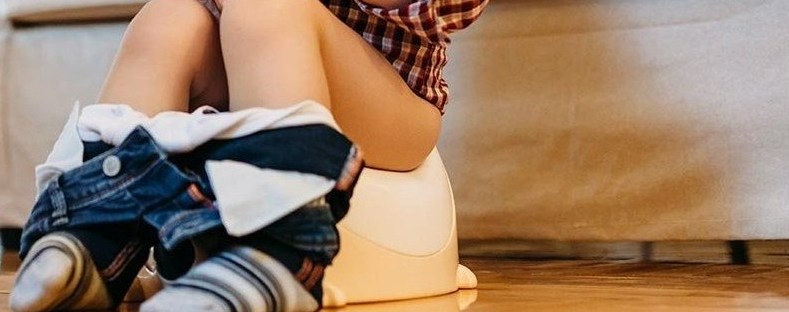
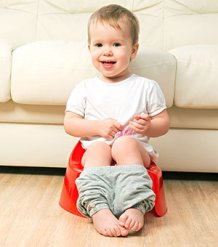 eting mastered and need a new skill to conquer). This means no overalls, no onesies (they come in sizes up to 24mth now!), no tight or stiff jeans, and no snaps, buttons, or zippers that need fidgeting. It even means no drawstrings (that require tying). You’re looking for comfortable, pull-on track pants, joggers, or looser leggings that will slide down easily without having to undo anything, slide down low enough to not impede sitting position, and slide back easily with nothing to have to do up.
 If you are trying or intending to night train your child, all of this applies to nighttime, too. One-piece sleepers are cute and warm, but difficult to get off quickly for a parent and almost impossible for a child who is just learning to use the potty. Two-piece pajamas are absolutely a more practical choice for toilet learning – at any age.
 Go Diaper Free with Ruthann Drummond, Certified Consultant & Coach