
Potty Training

Pandemic Potty Training

It has been too long since you’ve heard from me. Sorry! As I’m sure every one of you knows, this year has been strange. Things have been different. Things will never be the same.

Apart from the obvious pandemic, our family welcomed a new baby into our family, so we are starting a new journey to toilet independence all over again. Our Little Dude had his first EC catch when he was 2 days old, and has been on the potty every day since. I have no idea when he will finish – every child has their own unique journey – but I am confident that his experience with EC will serve him well when it’s time to potty train, just as it did for his brothers.

While the pandemic has been so hard in so many ways (our baby is still waiting to meet his grandparents 😦 ), it has also presented some unique opportunities to some families. I have had many clients who have decided to take on potty training because they are home with their children, when they may have delayed jumping in, either because they just didn’t have enough time with their kids, or in the vague hope that daycare would spearhead it for them. I have seen parents newly able to tune into their children’s signals, improve their communication and reduce their power struggles. While their have certainly been many challenges (like juggling full-time work from home while entertaining and homeschooling stir-crazy little ones during all the shut-downs), some parents have managed to embrace the rare opportunity this time has given them to connect in new ways to their children and come up with creative approaches to make sure everything (or almost everything) still gets done.

July is often a month of panic for some families with potty training on their minds. Often, parents are concerned that their children, entering Kindergarten or a new preschool with potty training requirements just won’t be ready in time. This year, with so much uncertainty about how the new school year will unfold, these feelings may be even more complicated or more intense.

Breathe.

We have come so far. As a family. As a community. As a country. We will get through this together. We’ve got each other’s backs.

Take this time – this strange, scary, confusing, but also unique time – to notice and get to know your children in a new way. Be creative. Be compassionate. This time is just as overwhelming and confusing for them. Work together as a family and be there for one another.

If your child has yet to begin their journey to toilet independence, this might be a great time to start. Whether you have a child closing in on Kindergarten who needs to potty train quickly, a toddler who you’d like to see take charge of their own hygiene needs, or a baby who you’d like to help keep attuned to their body through Elimination Communication, having a little extra time together might give you a rare opportunity to help them along their journey with deepened communication and understanding – something that will only help to bring you both success and a shared feeling of pride in your achievements.

Be well. You’ve got this.

silhouette-of-man-touching-woman-against-sunset-sky-256807


Elimination Communication, Potty Independence, Potty Training

Spring Has Sprung!

It’s finally here! I hope, wherever you are, you have had a lovely winter. In Toronto, it has been long, cold, and full of inhospitable weather! I love a nice snowfall, winter play, and being outdoors, but this year’s extreme cold, preponderance of freezing rain/ice pellets/rains followed by flash freezing/ etc. have made enjoying the winter with my two kids under 4 a challenge. However, with the arrival of the first day of spring we have finally seen some temperatures above zero and the melting of the massive amount of ice that had accumulated under the snow this season. Spring has arrived – I’m sure we’ll be seeing those first blossoms soon!

Not that we didn’t get some benefits out of winter… Since my youngest started his potty training in November, he has made his journey to potty training completion through the cold wintry days. We have thus mastered things like stand-up pees in snowsuits, and giving enough warning of an impending pee to get somewhere appropriate earlier than we did with his older brother. Winter was a time of transformation, and I am glad we had it, but I am certainly ready to move on!

While I wouldn’t normally advise a family contemplating potty training to wait until spring, I am also mindful of how intimidating the extra complications of snowsuits and multiple layers can bring. I recently wrote about simplifying how we dress our little ones to set them up for success, and winter doesn’t simplify anything! I have observed that most people tend to begin their family’s potty training journey in the spring or summer, when clothes are simple and some people have the opportunity to spend much more time outside. If you’ve been waiting, now’s your chance!

Especially if you have a child who will be starting at a new school in September, and you’re hoping they’ll be out of diapers by then, I would strongly encourage you not to wait until summer. Why? Because this will add pressure to you, the parent (as you sense a looming “deadline” for completion), and you will not be able to feel that kind of pressure and stress without it transferring to your child. If there’s one thing kids are really, really good at, it is sensing and mirroring emotions and stress in us. And if there’s one thing that is sure to derail your potty training process, it’s stress and pressure.

If you’re familiar with my posts or my practice, you’ll know that I believe the potty learning journey can begin at any age in a healthy and supportive way, through either Elimination Communication (for 0-18mth) or Non-Coercive Potty Training (18mth+). Kids are ready to learn at any age, so when potty training happens (for children 18mth+) actually depends on when parents are ready to start.

Why not start now?!

Elimination Communication, Potty Independence, Potty Training

Dress for Success! – Avoiding the drawbacks of modern clothing in independent toilet learning

For the last 5 decades, the average age of potty training completion has been rising. Yes, this has to do with a deeply-instilled fear due to the success of the “wait for readiness” campaign. Yes, it has to do with social changes that have both parents working and with less available time to dedicate to things like potty training. Yes, it has to do with a more complicated lifestyle where we’re over-scheduled and under-rested. But there are some other more hidden aspects of our modern lives that can also hinder toilet learning, and that’s what I want to talk about today.

Ivintage boys on chamber potsf you’ve seen vintage images of babies from a few generations ago, you may have noticed that both girls and boys were most often dressed in flowy gowns, which made for easy access to their cloth diapers or bare bottoms. What you may not have known is that those children, on average, completed their potty training by 18mths. In those days, as soon as you started to walk, you started to learn to use the potty. And the babies and parents were successful in this not only because they were confident in their abilities (since this was the social norm and expectation), but also because they were dressed in a way that made getting to the potty as easy as possible, removing an extra obstacle that can hinder the process.

As with anything we do, potty training, no matter what age we start it with our children, requires us (or, more accurately, our child) to dress for success! Now, I don’t mean little bow ties and cute dresses (although that would be adorable!), but rather the idea that if you want your child to succeed in their potty learning journey, you need to set both them and yourself up for the least possible hassle and fuss. This means easy on and off for quick trips to the potty or toilet, and for toddlers and older children it means clothing they can manipulate independently without trouble.

onesieLet’s talk onesies for the younger set. Onesies are possibly the most commonly thought of baby clothing item. They’re small, easy to store and care for, not too expensive, and they don’t hike up in a car seat, stroller or carrier. They hide the diaper and look tidy under a cute pair of pants. All wins! So, what’s the issue? The snaps are the issue. Those snaps add one level of complexity – one more thing to fuss with – on the journey to the potty, and after not that long it can feel quite cumbersome to undo and redo them several times a day. It can end up being a deterrent strong enough that you just don’t want to bother doing it. Not exactly a recipe for success.


HG0XMm7g

If you are practicing Elimination Communication with your baby for the first time and are already feeling a little overwhelmed by the process (or even if you’re not!), ditch the onesies! T-shirts, diaper and legwarmers are a warm and practical way to dress. This way, all you have to do is remove the diaper. There are no extra steps! If you’re going out, leave off the legwarmers and go with pants instead, but quickly yanking off the pants and having access to the diaper is still going to be easier than fussing with the snaps of a onesie once the pants are off.

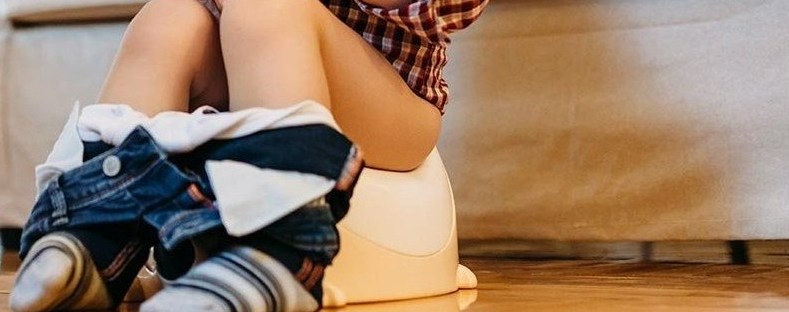
For to1f3203c103b95dcc42e850828c152cea--leather-suspenders-leather-beltsddlers who are just beginning to learn about manipulating clothing, and for preschoolers who can manipulate some clothing, dressing for success means dressing for the easiest, least-frustrating pants on/off scenario possible (at least until they have toilBaby-sitting-on-a-potty-chair-with-his-pants-downeting mastered and need a new skill to conquer). This means no overalls, no onesies (they come in sizes up to 24mth now!), no tight or stiff jeans, and no snaps, buttons, or zippers that need fidgeting. It even means no drawstrings (that require tying). You’re looking for comfortable, pull-on track pants, joggers, or looser leggings that will slide down easily without having to undo anything, slide down low enough to not impede sitting position, and slide back easily with nothing to have to do up.
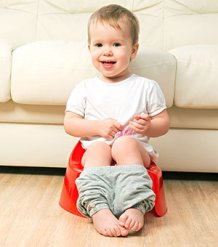

d33cf75b10feb3cb577ef145def6606bIf you are trying or intending to night train your child, all of this applies to nighttime, too. One-piece sleepers are cute and warm, but difficult to get off quickly for a parent and almost impossible for a child who is just learning to use the potty. Two-piece pajamas are absolutely a more practical choice for toilet learning – at any age.
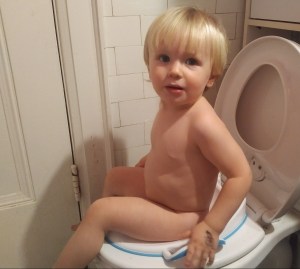
If you’ve ever struggled to get a toddler or preschooler in the toilet learning process to the potty in time, you know how important a couple of extra seconds can be. Dressing for ease in toileting will help you and your child to achieve potty success!

Elimination Communication, Potty Independence, Potty Training

Is EC A Lot Of Work?

This is a common question I get. Isn’t practicing Elimination Communication really hard? Doesn’t it take a lot of time? Isn’t it exhausting? Doesn’t your whole life then revolve around your baby’s toileting needs?

First off, EC isn’t hard, parenting is! EC is just another tool in the parenting repertoire. It’s goal is to enhance the communication between parents and babies 0-18mth, specifically around toileting needs, but this enhanced communication and attentiveness tends to pour over into other interactions, and ECing parents often feel more attuned to their babies because of it. Being more in sync with your baby actually makes parenting a lot easier, in both the short and long term! Are there frustrating times when you practice EC? Yes. Will it always make sense? Nope. But once you establish an EC practice in your home and it becomes normalized as part of your life, it’s not hard, it’s just routine. And in the long run, it’s a routine that makes your life much easier!

In terms of the amount of time it takes, or the “extra work” it is, that’s all a matter of perspective. Does it take a lot of time to take a baby to the potty several times a day? Perhaps. But so does changing that same baby’s poopy diaper, and I can guarantee a potty success is more fun for both of you! Does an EC family spend more time doing toileting-related things? In the short-term, absolutely. But that same family is much less likely to be changing the diapers of their 3 year old when the time comes. They are also less likely to experience power struggles over potty training that can be emotionally taxing on everyone. And they are much more likely to have a toilet independent child between the ages of 18mth and 2.5years, eliminating a tonne of diaper waste, and/or drastically reducing the laundry for cloth diapers. When people tell me that they couldn’t even think about EC because it seems like so much work, my response is to say that I couldn’t think of having to change diapers on an older toddler or preschooler and going through a later-age potty training process because that THAT seems like a lot of work and completely exhausting. Give me a toddler out of diapers and an organic path to toilet independence without power struggles any day!

All parents do a lot of work. All parents do a lot of work surrounding toileting. It’s how we distribute that work that is different. All it is, is a shift in perspective.

Those who believe that EC takes over your life, and all you ever do is think about pottying are mistaken. EC can be practiced full-time, part-time or even casually, and the process is beneficial no matter which path you choose. In fact, it is often the case that families practicing part-time have toddlers out of diapers sooner than those practicing full-time, because they tend to give their kids more room to breathe in the process, which removes any [unintended] pressures. EC also doesn’t mean you have naked babies all the time who pee on the floor. Diaper free time every day has been shown to be beneficial to all babies, but ECing families almost always use a backup of some kind, and usually that’s a diaper. EC isn’t reserved for crazy people or toileting extremists – almost anyone can practice it within their life context without it becoming overwhelming, weird, or unsanitary!

Elimination Communication, Potty Training

Our 18mth Old Is Potty Trained!

IMG_20181203_2027589

Our 18mth old is now potty trained! I wanted to share my story, to help other families feel confident in their early potty training, too.

First, some back story: I practiced Elimination Communication with both of my kids from the first couple weeks of life. Since they were newborn, they have been used to peeing and pooping while sitting on or being held over potties and toilets – at least some of the time.

With our first, we practiced focused EC part-time, tuning into our child’s toileting needs while still having him in a diaper backup, and making a conscious choice to rely on a diaper in certain situations (i.e. when in music class, on car trips, in snowsuits, etc.). He took to EC very well from the start and would sit on the potty happily for long periods of time, which increased his catches. By 11mths, he naturally stopped pooping anywhere other than the potty, and would never poop when out and about. Because of this, by 14mths I decided we would ditch daytime diapers and work on getting him more consistent with pees. This ended up being a long road, possibly because we used cloth training pants which may have slowed down his learning, and more probably because our lives got busier around that time, and we didn’t have as much focus on the process. At 19.5mths, he was still not consistent with his pees, so I planned to “finish up” his EC with a potty training experience and picked a date for 3 weeks later. But 2 weeks after that, something just “clicked” for him, and everything started falling into place. He was potty trained at 21mths.

The experience with our second has been very different (as it always is!). We started off with great success as an infant, and were very excited about how his process was going, especially since our focus and time was now split between two little people. And then, at 8.5mths, he learned to crawl. He is a very, VERY active and inquisitive boy, who was excited by his new-found mobility and was NOT willing to sit still on the potty to wait for a pee or poop, as our first had been. There were places to go, things to explore, stuff to climb! Our catches plummeted, and rather than being a typical potty pause of 3-14 days, he just wasn’t coming out of this phase. 11mths came and passed and there was still no sign of less poops in diapers. 14 mths came and passed and still there was little progress. At 16mths, I felt diaper exhausted (this was 7 mths longer than my first used diapers already!), and also discouraged by his whole toilet learning journey. We felt drained and unable to put the energy into his EC practice when we weren’t seeing results, and EC became a pretty casual thing that we were doing daily, but with way less focus. He was still learning important steps, like mounting a potty on his own, but using one was a different matter. I decided that we needed to regroup and refocus, and that this time we would go for it and pick a date for a potty training experience weekend to help things to “click.” That weekend was last weekend, and at 18mths old, our second child is potty trained!

As an EC and potty training consultant & coach, I am really excited by this, because now I’ve personally experienced success happen both organically when an EC practice is really solid, and also with a preemptive potty training “finish up,” when EC was a little more nebulous. And while I have coached families through potty training their children, it was an illuminating experience to do it with my own. I am proud of our accomplishments, and excited about my new insights and confidence in how these processes can work (both separately and together) to help our children reach potty independence sooner!