
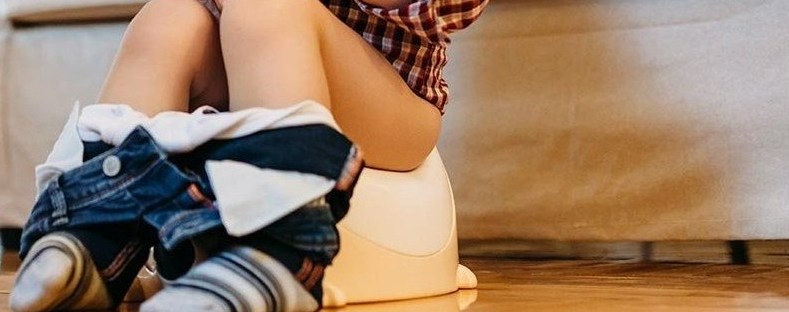
For the last 5 decades, the average age of potty training completion has been rising. Yes, this has to do with a deeply-instilled fear due to the success of the “wait for readiness” campaign. Yes, it has to do with social changes that have both parents working and with less available time to dedicate to things like potty training. Yes, it has to do with a more complicated lifestyle where we’re over-scheduled and under-rested. But there are some other more hidden aspects of our modern lives that can also hinder toilet learning, and that’s what I want to talk about today.
I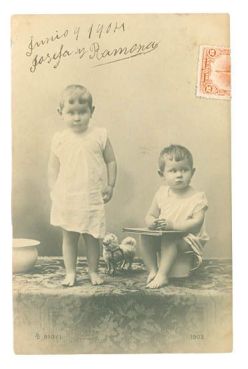 f you’ve seen vintage images of babies from a few generations ago, you may have noticed that both girls and boys were most often dressed in flowy gowns, which made for easy access to their cloth diapers or bare bottoms. What you may not have known is that those children, on average, completed their potty training by 18mths. In those days, as soon as you started to walk, you started to learn to use the potty. And the babies and parents were successful in this not only because they were confident in their abilities (since this was the social norm and expectation), but also because they were dressed in a way that made getting to the potty as easy as possible, removing an extra obstacle that can hinder the process.
As with anything we do, potty training, no matter what age we start it with our children, requires us (or, more accurately, our child) to dress for success! Now, I don’t mean little bow ties and cute dresses (although that would be adorable!), but rather the idea that if you want your child to succeed in their potty learning journey, you need to set both them and yourself up for the least possible hassle and fuss. This means easy on and off for quick trips to the potty or toilet, and for toddlers and older children it means clothing they can manipulate independently without trouble.
 Let’s talk onesies for the younger set. Onesies are possibly the most commonly thought of baby clothing item. They’re small, easy to store and care for, not too expensive, and they don’t hike up in a car seat, stroller or carrier. They hide the diaper and look tidy under a cute pair of pants. All wins! So, what’s the issue? The snaps are the issue. Those snaps add one level of complexity – one more thing to fuss with – on the journey to the potty, and after not that long it can feel quite cumbersome to undo and redo them several times a day. It can end up being a deterrent strong enough that you just don’t want to bother doing it. Not exactly a recipe for success.
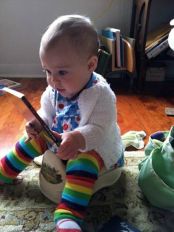
If you are practicing Elimination Communication with your baby for the first time and are already feeling a little overwhelmed by the process (or even if you’re not!), ditch the onesies! T-shirts, diaper and legwarmers are a warm and practical way to dress. This way, all you have to do is remove the diaper. There are no extra steps! If you’re going out, leave off the legwarmers and go with pants instead, but quickly yanking off the pants and having access to the diaper is still going to be easier than fussing with the snaps of a onesie once the pants are off.
For to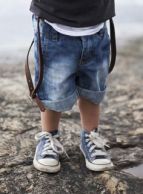 ddlers who are just beginning to learn about manipulating clothing, and for preschoolers who can manipulate some clothing, dressing for success means dressing for the easiest, least-frustrating pants on/off scenario possible (at least until they have toil
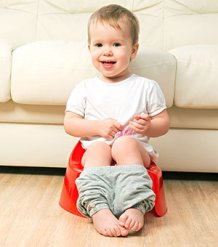 eting mastered and need a new skill to conquer). This means no overalls, no onesies (they come in sizes up to 24mth now!), no tight or stiff jeans, and no snaps, buttons, or zippers that need fidgeting. It even means no drawstrings (that require tying). You’re looking for comfortable, pull-on track pants, joggers, or looser leggings that will slide down easily without having to undo anything, slide down low enough to not impede sitting position, and slide back easily with nothing to have to do up.
 If you are trying or intending to night train your child, all of this applies to nighttime, too. One-piece sleepers are cute and warm, but difficult to get off quickly for a parent and almost impossible for a child who is just learning to use the potty. Two-piece pajamas are absolutely a more practical choice for toilet learning – at any age.
If you’ve ever struggled to get a toddler or preschooler in the toilet learning process to the potty in time, you know how important a couple of extra seconds can be. Dressing for ease in toileting will help you and your child to achieve potty success!
 Go Diaper Free with Ruthann Drummond, Certified Consultant & Coach