
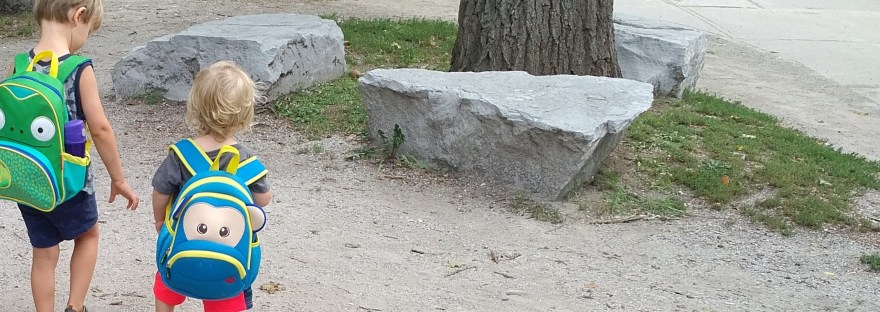
September. It’s the start of Autumn; a time of transition. For many people it’s back to a regular routine. It’s back to school, too: back to teaching and back to learning. What better time could there be to begin your family’s journey to toilet independence?
If you have (or care for) a baby 0-18mth, elimination communication is an amazing way for you and your baby to teach and learn from each other. It focuses on finding ways to communicate about elimination needs, and on learning to listen to and tune into each other in new and profound ways. For toddlers and preschoolers (18mth+), potty training is the unlocking and mastering of a whole new set of skills – an empowering right of passage.
If you don’t have time to read this whole post, I would encourage you to take a look at the video of my younger son demonstrating how he gets to and sits on a potty. He takes delight in the process and shows that even very young toddlers (he’s 15mth) can learn to take themselves to a potty without force, coercion, or trauma:
https://www.youtube.com/watch?v=VpK2rxHo7l0
Some of the confusion surrounding potty training in today’s society is the pervasive idea that children must wait to begin their toilet learning until they have somehow met a set of “readiness” requirements. That, one magical day, a child will spontaneously show interest in using a potty or toilet for the first time, and from that point on the road to a potty-trained child should be straightforward and fairly easy. This is nonsensical, for two reasons:
It presumes that your child is not ready to learn.
To not be ready to learn new things, one must either be lacking physical or developmental ability, or one must be missing the prerequisite information. Neither is true.
A common myth that is parroted about the parenting and medical communities is that babies up until 18mth do not have awareness of when they eliminate, and do not possess sphincter control. As the mom of a baby who began pooping in a potty at 3 weeks old, never pooped outside the house (or a house we were visiting) after 4 months old, and had his last poopy diaper ever at 11 months old, I can confidently tell you that babies are born with sphincter control and awareness of when they eliminate. The issue arises when we rely exclusively on diapers for elimination needs. This teaches babies that the appropriate place to eliminate is in their diaper, that they will never be required to hold their pee or poop, and when disposables are used, it takes away the sensation of wetness that helps babies to stay attuned to their own bodies and when they pee.
As for prerequisite information – how could there be any? This is one of our very basic needs. From the day we are born, we need to pee and poop. You don’t have to know anything more than that to be ready to learn when and where to do it!
It presumes that toilet learning must be child-led and initiated, rather than parent-led and taught.
Potty training doesn’t have to be an anxious waiting game. Children don’t spontaneously show interest in a potty. They can watch and mimic their role models, looking for ways to be more grown up (which relies on parents teaching their children through modelling and active engagement in the potty process), or, as is all-to-common, they can feel peer pressure to use a potty or toilet like their friends do in childcare or preschool settings, and then seek to fit in with their friends.
Toilet learning can begin now, no matter how old your child is. They have the ability, they have the prerequisites. All they need is the teacher – and that’s you!
There’s a common myth that scares parents into waiting indefinitely: that early potty training will cause psychological damage to your child. If that were the case, it would be scary! What isn’t explained is the caveat. The issues arise when potty training is forced. Who being forced into something doesn’t experience some degree of psychological damage, never mind a baby or young child! Starting young (whether at 1 day or 18mth+) doesn’t mean the process is in any way forced. If you honour your child’s abilities, respect their desire to learn, and step into the role of their teacher, toilet learning can be a natural and organic process beginning at any age, without fear of causing damage.
If you didn’t view it above, here is a video of my younger son demonstrating just a little of the teaching in our house. At 15mth, he gets himself onto the potty on his own, and is delighted by the process!:
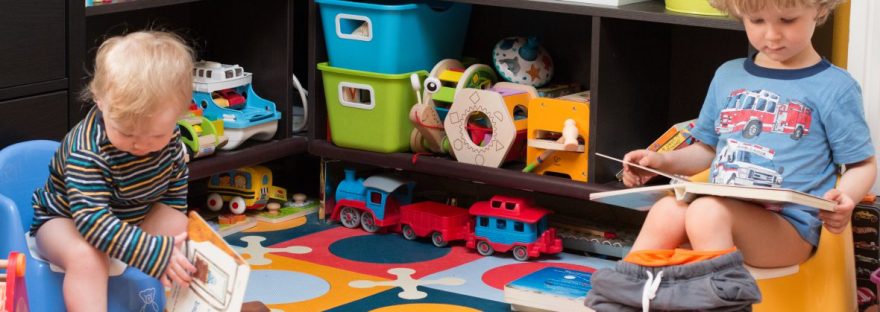
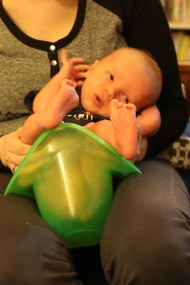 families embark on their own journeys to potty independence! My own family’s adventure began a little over three years ago, when my first son was 2 weeks old. I had stumbled across information on
  daytime diapers for good. Although we hit some pretty rough (so, so rough!) bumps on the road, our little guy was completely
 Go Diaper Free with Ruthann Drummond, Certified Consultant & Coach