Potty Independence, Potty Training, Uncategorized

Is Early Potty Training Harder Than Waiting Until A Child Is Older?

5833_461017360646505_1772636298_n

No. In fact, there is much evidence to indicate that it is easiest to potty train a child between the ages of 18 and 29 months. Around 2.5 years, there is a developmental shift that brings about new testing behaviours and it is much easier to fall into difficult power struggles that can derail the process. By potty training your child as a toddler, rather than a preschooler, you avoid a lot of this complication and establish toileting as a regular part of their day and a simple matter of course.

Parents build up potty training as something to be feared. They are afraid that it will take a lot of time and be a lot of work. They are afraid of accidents, especially while out and about. They are afraid they will fail and stunt their child’s toileting journey.

Potty training DOES take time and IS a lot of work, but that doesn’t change whether you start it at 18 months or at 3 years. The process requires dedication and focus from parents, no matter the age you’re starting from. All it does is change the amount of time you will be changing your toddler or preschooler’s diapers. And THAT is a lot of work!

Accidents WILL happen. It doesn’t matter if you have a non-verbal toddler or a fully conversational preschooler. Learning to identify bodily signals when you have been used to using a diaper as an instant toilet takes practice, and it’s a learning curve no matter how old you are or how honed your communication skills are. Some parents think they can wait until 4 years old and it will be easy because their child will just know what to do. In reality, older children are even further removed from an understanding of their bodily functions – their learning curve is steep and their habits are more entrenched.

Will your child have accidents? Yes. Is it something to be feared? No, it is not. Young children aren’t old enough to be embarrassed by them, and anyone who has any experience with children won’t even give you a second glance. The key is to be prepared. Rather than traveling with diapers, you will be traveling with changes of clothes at the ready. It’s a small shift in preparedness, that’s all.

Can you derail your child’s toileting journey if you start when they’re young? Well, yes. Do you have to? No, absolutely not. Parents are their child’s most important teachers and leaders in the potty training process, but they are also very capable of projecting their own stresses and fears on their children. If you are stressed about potty training, so will your child be. If you don’t believe that your toddler is “ready” to potty train, they won’t believe they are ready either. If, however, you have confidence in your child and your ability to guide them, you can move them toward toilet independence at a very early age. It just takes dedication, focus, and a belief in your and your child’s abilities. Toilet independence is just around the corner. Your child is ready now. Are you?

Elimination Communication, Potty Independence, Potty Training

Is There a “Right” Time to Potty Train?

Just as there is never a perfect time to get married, or the perfect time to have a baby, you may never feel like there is a perfect time to potty train.

Our cultural messaging leads us to be apprehensive of the potty training process to begin with (I’ve written about that, here). We fear doing it the “wrong” way, and sabotaging the process. We fear pressuring our kids or causing them any kind of trauma or damage. We worry our kids aren’t “ready.” We dread others’ opinions and advice (Don’t leave it too late!; don’t push it too early!) Add in our complicated lives, our over-extended schedules, and our constant connectedness through technology, and it’s no wonder parents are putting off potty training until later and later with each passing year.

So, when is the “right” time to start your child’s journey to potty independence? The interesting thing is that the answer depends entirely on you, and not your child.

Your child is ready to begin their journey now, no matter their age or abilities. For young babies, this will likely be through Elimination Communication to start, but toddlers as young as 18 months (and in some cases, younger) are fully capable of potty training. It doesn’t matter if they “show interest.” It doesn’t matter if they can “sing the ABC song.” It doesn’t matter if they can verbalize at all.

In just 2 generations, Western culture has forgotten its entire history of successfully potty training children by 18mth of age, but this is actually still the norm throughout most of the world. Read about the Myth of Readiness, if you are interested in this topic.

So, if our children are ready, what’s stopping us from doing this right now? Well, we are – the parents. It’s our stress, our worry, our investment in keeping every scheduled activity under the sun, our fear of failure and our lack of confidence and clear purpose in the process. Successful potty training requires dedication and focus, and an attitude shift that prioritizes your child’s toilet learning over other things in your life… for a very short time. In reality, it’s a tiny blip in your relationship with your child, that will give the gift of toilet independence for life.

If you are waiting for the perfect time to potty train, it may never come. You, the parent, have to make it the right time to potty train. You have to decide that teaching your child to take care of their personal hygiene needs, ditching the mess and waste (not to mention, expense!) of diapers, and completing this important right of passage is important enough to you and your child that you will make it a priority. You, the parent, have to let go of any stresses that are holding you back. You, the parent, have to proceed with clarity and confidence, becoming a teacher and guide for your child.

So, when should you start? The earlier the better, as long as you can wrap your head around the importance of the task and the commitment it requires. A casual attitude from the parent will result in a casual attitude from the child. You can have the same success in 12 days as you would have in 12 months – all without causing any damage to your child or using any coercive methods. It’s all in the attitude with which you approach it!

Give yourself permission to trust in your child’s ability as a learner, and in you as a teacher. Give yourself permission to prioritize this process for a short time, even if it clashes with your scheduled activities. Give yourself permission to take the process seriously, and to set clear boundaries for your child so they can take it seriously, too. Toddlers feel more secure and freer to explore within known limits and established expectations – give them the gift of that security. And once you’ve wrapped your head around all of that… go for it. Begin now!

Now, is the right time to start!

Elimination Communication, Potty Independence, Potty Training, Products

Navigating Gear, Part 1 – What potty should I buy?

Modern society likes its gadgets and conveniences, and EC and potty training is no different. There is almost an infinite array of potties, training pants, books, clothing, etc. all marketed as being what you NEED to get your kid to toilet independence. But do you? Well, no. You don’t actually need a thing except a kid, the clothes you want them to wear, and the place you want them to eliminate. However, as with everything, sometimes the right tool DOES make a job easier. Thus, I will occasionally be posting about navigating gear, to help you understand what’s out there, what it’s used for, and most importantly, to help you decide what might be right for your family. If you want to see a list of tools and resources that I have experienced having success, have a look at our Resources page. Topic #1 is one of the most important to both EC and potty training – the potties themselves!

First and foremost, do you NEED a potty? Well, no. But I do recommend them, and this is why: Potties are the easiest way for your child to do their potty routine on their own. For me, any inconvenience a potty might bring into your life is made up for 1000x by your child’s ability to be completely independent on a potty from a very young age. If you have to help lift your child onto a toilet, or help them feel secure by helping to hold them on top of the toilet. Or if you have to go with your child and let them into a child-proof locked bathroom every time they have to pee, then they don’t get to achieve the same level of independence they could have with a potty they can freely access. And ultimately, potty training is about empowering our kids to take control of their own hygiene needs. To be independent.

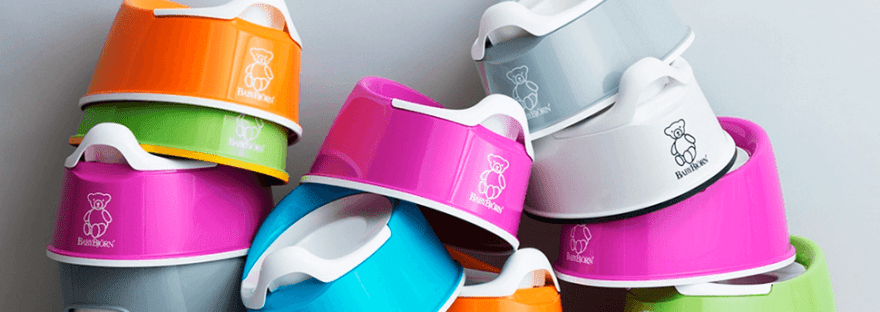
Potties come in many shapes and sizes, with many different features and intended uses. I will break this down into simple potties, potties with inserts, travel potties, and top hat potties. There are other specialty potties out there which I will touch on briefly, but we’ll stick mostly to the primary types here so you can get to know them. We will cover toilet seat adapters in another post.

Simple Potties

Simple potties are just that – they are very simple. They are all in one piece, making them easy to clean well because they have no seams or extra pieces. However, you must take the whole unit to the toilet to dump it every time your child eliminates, which some find cumbersome. For stable toddlers who are fairly easy going, these are a fine (and economical) choice. You can generally get one for under $10. However, if you are practicing EC with baby, you have a child who is particular about what they sit on, or you prefer to cart a smaller vessel of pee and poo to the toilet, a potty with insert may serve you better.

Simple Potties with Inserts

The low-profile, basic layout of a simple potty, but with a removable insert that you dump in the toilet. For my family, the inserts make them easier to use, because dumping a whole potty can be awkward (especially in a small bathroom). As an added bonus, if you’re practicing EC with a newborn or young baby, the insert can come out and [with most models] sit between your legs while you potty your infant on your lap. If you want to be able to sit up a young baby and give them a little more support (or you have a toddler who wants to feel secure), a potty chair may be a better fit for you.

Potty Chairs with Inserts

Potty Chairs always come with inserts, so you have built-in convenient dumping. As with the simple potties with inserts, you can use the insert to practice EC with a baby on your lap. Where potty chairs have the advantage is with the added security of a full back support. This is very useful if you are sitting a young baby without full control on the potty independently, or if you have a toddler who prefers the look or feel of a full-back potty for their own security.


 Travel Potties


Travel potties are compact, so they are usually shorter (lower) than regular potties and while great for travel, aren’t usually preferred by kids for everyday. Travel potties usually fold up. Some have covers so you can take the contents with you to dump later; some have disposable liner options, so you can bag the contents and throw them in the trash. Some clever designs can double as a toilet seat adapter, which can be really handy if you want to flip flop between public washrooms and no washrooms at all, or even if you want to use them as adapters at home. Because of their small size, they typically accommodate tiny bums easily, so can be great for EC and early potty trainers. Older toddlers may find them awkward to use because of their size, especially if they haven’t grown up accustomed to them.


Top Hat Potties

These potties are great for EC from birth to 6mth. Small and simple, they fit perfectly between your legs for convenient pottying in a classic EC position with you as a support. You can get or make fleece cuffs that keep the tiniest of bottoms from feeling chilly, too.


Specialty Potties and Potties with Bells and Whistles

While I ultimately support any potty that gets your child out of diapers and onto potties and toilets, I will be honest and say that I am not the biggest fan of the flashy, musical, ready-to-drive, “fun” potties with lights, music, screens and who knows what else. We are teaching our children to pee and poop in an appropriate receptacle that will ultimately evolve into only a toilet because it’s a matter of course. We have to pee and poop… we have to put that pee and poop somewhere… our society has deemed toilets as that place. Flashy potties with buttons, steering wheels, etc., that are partly used as toys, seem to defeat the matter of fact attitude we are adopting about this process while learning to deal hygienically with our bodily functions. But some families may find that they work for them, and that’s just fine.

There are also some specialty potties out there with disposable liners so you theoretically never have to wash them but can either flush or dispose of single use potty bags. While I understand that we are all searching for a little more convenience, this just seems excessive, both in terms of cost, and environmental impact.

I hope you find what you are looking for, and your family ends up with the potty of your dreams! For particular products that I have witnessed working for families, please visit our Resources page. And always feel free to Contact Us, if you need any further guidance!

 

Elimination Communication, Potty Independence, Potty Training

Scared to Potty Train?

img_20181023_0017041.jpg

With Halloween approaching, what better time is there to talk about our fears?! A common sentiment is that parents are scared to potty train. Scared of power struggles, scared of causing psychological damage, scared of accidents and messes, scared that their child won’t be “ready,” and scared that they won’t know what to do and it will fail.

Only a couple of generations ago, potty training was a simple matter of course. There was a culture of potty training at an early age which began as soon as a baby could walk. Toilet independence by 17-20 months worked because it was expected to work – because parents saw it working all around them, and they were confident both in their child’s ability to learn this skill, and in their own ability to teach it. Potty training was part of our cultural knowledge, and was passed down through the generations.

In the middle of the 20th Century, things began to change. I am not going to write about the entire history in this post, but know that the pendulum swung to an extreme of parent-imposed, fear-based methods that caused a lot of psychological and physiological damage, and then, in reaction, swung to the other extreme to a child-led approach that relied on waiting for a child to take the initiative to potty train. Through all of this, our culture was robbed of a whole body of knowledge that had parents leading their children through potty training effectively and without coercive methods, and doing so at a young age. We became so worried about damaging our children after the first experience with extreme methods (and rightly so!), that we never let ourselves balance out. We are still stuck in an extreme, but it is past serving its purpose. After releasing our children from fear-based approaches, we failed to recognize that parents became trapped in a culture of fear of potty training themselves.

The fear of psychological damage is deeply rooted, but based on coercive, pressure-ridden, fear-based methods. Potty training children at a very young age will not cause any damage, if done in a supportive, gentle, non-coercive way. This is proven over and over again by the potty training ages you see everywhere outside of the Western world – children all over the globe are potty trained between 12 and 18 months. Why should our children be any different? If you have not yet read my page on the Readiness Myth, please do have a look!

The fear of accidents and messes can be very real for some parents, yet it is so easy to deal with if given a little thought and preparation. There are ways to protect your house – your flooring and furniture – from accidents, especially in those first few days of the most intensive learning. This is a very short-term problem and it has many solutions. Accidents are part of the child’s learning journey. By delaying potty training, your child won’t miraculously potty train overnight with no accidents. If you face this fear now, you won’t have to do so later, and you’ll save yourself a lot of diaper changes and diaper purchases as well!

The fear of power struggles can be huge for some families. If you already experience regular power struggles with your baby or toddler (over food, getting dressed, discipline, sleep, etc.), it’s true that you are likely to experience them with potty training as well. Keep in mind that toddlers thrive when they have clear and consistent boundaries within which they are secure in the knowledge that they understand the rules. As much as it seems like they want to be in charge, the opposite is actually true. Toddlers want to know that you have their backs, always. And they want to know that you are in charge of the situation, even when they are a completely dysregulated mess. Non-coercive potty training really works within this. It is gentle and without pressure, but it is parent-led and firm in its boundaries.

The fear of not knowing what to do and maybe even failing is a major roadblock for parents in our society. Our cultural knowledge is missing, and in its place is a chaotic garble of conflicting advice, unwanted opinion, and bizarre social media interactions. You don’t need to feel like you are floundering. If you are seeking support and community from like-minded parents, please join the Go Diaper Free of Toronto private Facebook Support Group. If you feel like you need more comprehensive support, learn how you can Work With Us, and always feel free to Contact Us for more information.

Halloween brings us a little spook, and a lot of fun. It lightens up fear, and lets us embrace the unknown, if only for a single night. So, in the spirit of Halloween, I invite anyone in fear of potty training to embrace that fear and face it head on! You CAN do this, and you can do it positively for both you and your child, and have a little fun (and a lot of pride!) along the way!

Elimination Communication, Potty Independence, Potty Training

Feeling Lucky!

turkey on potty

Happy Thanksgiving everyone!

This Thanksgiving, I want to take some time to remember how lucky I am. I am lucky to have two amazing little boys; they warm my heart, make me laugh, and tickle my soul every day (…most of the time 😉) and I couldn’t imagine my life without them! I am lucky to have an amazing partner – he’s a wonderful Dad who is involved in every aspect of our children’s lives, a loving and supportive companion who keeps me going when I’m low, and he really contributes his half to the running and nurturing of our family. I am lucky to have the extended family we have – my boys are so lucky to be growing up with four loving grandparents, and lots of wonderful aunts, uncles and cousins. I am lucky to have friends who always lend an ear when its needed, and who enrich our lives and help us out so much day-to-day. And I am lucky for all the amazing and interesting people who I teach; they each add something new to my understanding of the complexity and uniqueness of individual life contexts, and how important those are to the ways we learn and approach tasks in our lives. I am truly thankful to be so lucky in all of this.

I am also thankful that I happened upon some information on Elimination Communication before my first son was born, and that I had the time and resources I needed to research it more. I am thankful that I had the confidence and determination to commit to practicing it, even though it’s unusual in North American society. And I am thankful for all of its results: that it brought me closer to my boys and deepened our communication; that it kept my boys in touch with their own bodies and elimination needs, helping to empower them in the process; that it helped our family reduce its environmental impact through fewer cloth diapers washed and fewer disposable diapers thrown out; that it helped our family to save money on diapers and laundry; and that it led to our first son being potty trained in a stress-free organic process that was finished by 21mths (our second son is in progress at 16mths – I’ll have to report back!).

I am also thankful for my Go Diaper Free training – for being qualified to consult for and coach Elimination Communication and Non-Coercive Potty Training and for being in a position to help children and their families reach toilet independence faster and without pressure, no matter when they are beginning.

And, of course, I am thankful for all of you – My Go Diaper Free Family! And I want to wish everyone a very happy and healthy Thanksgiving!

What makes you feel lucky or why are you thankful?